
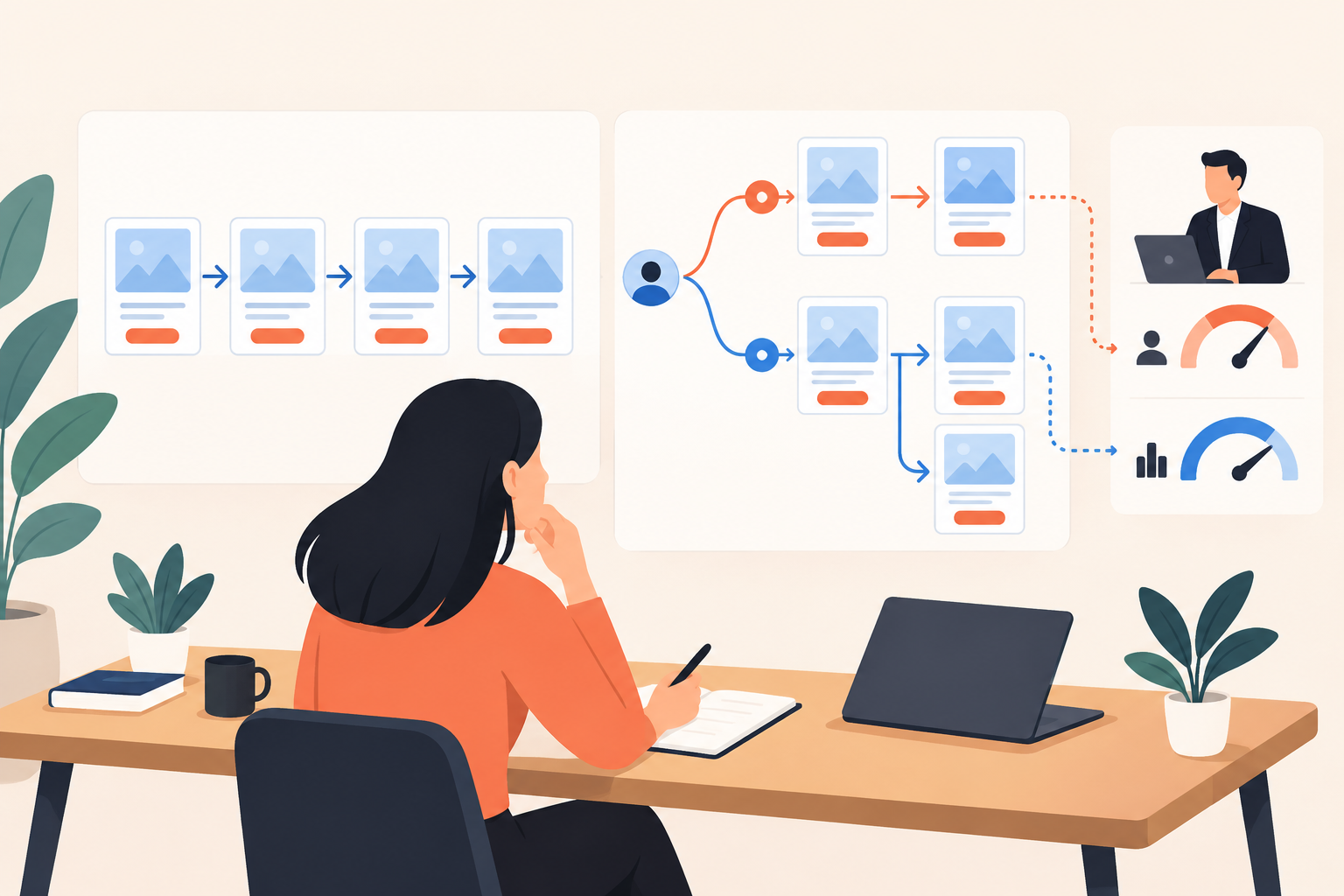
Your operations buyer wants to see what happens when an assignment fails. Their sales director wants to know how leads reach the right rep. You send both the same product tour, then ask sales to follow up because someone completed it. The demo worked technically. The handoff didn't.
If you're evaluating Storylane alternatives for buyer-led demos, test whether buyers can change the story, not just click through it. The right choice should adapt content to their priorities and give sales a useful starting point for the next conversation. Dale, the demo automation platform, is worth evaluating when you need role-based routing, buyer-selected depth, and separate intent and fit scores.
What should you look for in Storylane alternatives?
Look for a better way to serve your actual buyers, rather than a longer feature list. For role-based demos, that means testing audience routing, topic selection, content maintenance, and the handoff to sales together.
I wouldn't move a demo library because another editor looks easier in a vendor presentation. I'd consider moving if every new audience required another copy of the same story, or if reps still entered calls without knowing which problem the buyer wanted to solve.
Those are different problems from needing a polished feature tour. A product marketer explaining one workflow may reasonably prioritize publishing speed and visual control. A pre-sales lead supporting different industries needs to know how much content can be shared without making every buyer sit through the same explanation.
Keep Storylane in the test as your baseline. The Storylane comparison page can help frame questions, but ask each vendor to demonstrate current capabilities and confirm plan availability. This guide evaluates a specific workflow; it doesn't assume Storylane lacks a feature because another tool describes it differently.
Buyer-led personalization: The buyer's context and stated priorities determine what the demo shows and how much detail it provides. Changing a greeting is personalization too, but it doesn't change the sales story.
When do you need personalization instead of a fixed product tour?
You need personalization when different buyers need different evidence to judge the product. A fixed product tour is often enough when everyone needs to learn the same bounded task.
Take a hypothetical field operations platform. A tour showing how to create a task, assign an owner, and close it is useful. But someone evaluating missed follow-ups needs to see how exceptions surface and who gets notified. Someone evaluating management oversight needs to see what remains invisible until a manager checks a report.
The screens may overlap. The explanation shouldn't.
| Question | Fixed product tour | Buyer-led demo |
|---|---|---|
| Who chooses the story? | The author sets the sequence. | Buyer choices shape the content. |
| What happens to irrelevant material? | It may remain in the prepared path. | Topics can be excluded based on stated priorities. |
| What determines depth? | The prepared explanation. | The buyer's interest in each topic. |
| What should sales learn? | Which steps were explored. | Which problems mattered, supported by engagement. |
This is a comparison of approaches, not a vendor capability matrix. Interactive demo software can support different experiences, and clicking Next doesn't automatically make an experience buyer-led. Choose the approach that removes work for the buyer, not the one that adds the most choices.
How should role-based routing and topic selection work together?
Routing should establish context; topic selection should establish priorities within that context. A job title is a useful starting point, not a complete brief for a sales conversation.
Two sales leaders at lending businesses might use the same terminology but arrive with different concerns. One is losing track of incoming leads. The other already has assignment under control and needs better oversight. Routing both into a lending demo helps, but forcing both through the same presentation leaves the harder problem unsolved.
How do you choose the first routing question?
A Branched Demo uses preset choices, such as industry, role, or use case, to send viewers to a matching Linear Demo or Basic Demo (Single Experience Demo). Questions can be chained; free-text answers aren't supported today.
Ask the question that changes the explanation most. If industry changes terminology and supporting material, start there. If the workflow changes by role, route by role. Map the Branched Demo audience paths before producing more content.
Be strict about this. If every answer leads to essentially the same explanation, remove the question. You're collecting information, not helping the buyer.
How do buyers control the depth?
A Linear Demo lets viewers rate topics Important / Somewhat Important / Not Important. Important topics play first, and topics marked Not Important are omitted.
Pages hold the topic content. Each Page has a longer-video placeholder for Important and a shorter-video placeholder for Somewhat Important; you can use the same video for both. Optional Walkthroughs provide screenshot-based, step-by-step exploration after a topic's video.
The Linear Demo topic-priority model makes the distinction concrete: routing chooses the relevant room, while topic ratings choose the conversation inside it.
Write topics as buyer problems. “How do I catch unassigned leads?” gives someone a reason to choose. “Assignment module” mostly tells them how your product team organized the navigation.
What should sales learn from demo engagement?
Sales should learn what the buyer prioritized, what they explored, and what remains uncertain. A score should help a rep decide what to do next, not replace their judgment.
Imagine a prospect marks exception handling Important, replays that explanation, and downloads the related document. A useful follow-up asks how exceptions are handled today or offers a discussion of ownership rules. “I noticed you watched our demo” wastes the context you just collected.
Buying Intent Signals include topic ratings, rewatches, branch choices, Walkthroughs activity, link clicks, document downloads, and sharing. These indicate engagement. They don't prove budget, authority, or an imminent purchase.
Lead Scoring separates Intent from Fit, with each displayed on a 0-100 scale. Intent reflects behavior; Fit reflects attributes such as seniority, company size, and target industry. Weights, thresholds, signal points, and decay are configurable.
When reviewing the intent and fit scoring model, ask to see the evidence behind a contact's score. An engaged researcher outside your target market and a suitable buyer exploring a critical workflow shouldn't become indistinguishable activity alerts.
I also look for how the system treats missing information. Contacts who haven't opened a demo remain New, rather than Cold. That's the right distinction: no observed behavior isn't negative intent. Likewise, Not Important tells you which topic to leave out, not necessarily which account to disqualify.
How do you run a useful vendor evaluation?
Give each vendor the same buyer scenario and inspect both sides: what the buyer experiences and what the seller receives. Then change a shared piece of content to expose the maintenance work.
Use existing material, even if it's imperfect. A carefully prepared vendor sample tells you less about your future workload than your own awkward explanation of an exception workflow.
- Pick contrasting needs. For an illustrative test, use an operations leader concerned about exceptions and a sales leader concerned about assignment. Specify what should differ and what should stay shared.
- Change priorities within one role. Run the experience again with different topic choices. Check whether the content, order, and depth actually change.
- Inspect the seller record. Look for stated priorities, observed behavior, identification method, and the reasons behind any score.
- Hand that record to a rep. Without explaining the scenario, ask them to write an opening question and a follow-up. Their answer is a practical test of the data's usefulness.
- Update a shared explanation. Find out which experiences inherit the change and where manual work remains.
- Check the commercial boundaries. Confirm the plan required for routing, scoring, automation, and your CRM workflow before comparing costs.
Test identification separately. Public-link viewers are identified only when they submit details. Unique invite links associate activity with the invited contact without requiring another form. A website visitor and a known prospect receiving a follow-up link are different distribution cases; don't treat them as one analytics requirement.
Finally, try the experience on a phone. Make the same choices, open the supporting document, and attempt the next step. A desktop preview isn't a complete buyer test.
What migration work should you plan for?
Plan for content restructuring and follow-up ownership, not just rebuilding screens. Demo automation won't fix a library organized around internal feature names rather than buyer questions.
Sort your existing material into shared explanations, audience-specific context, and content worth retiring. A workflow recording might still be useful even if its introduction needs replacing. Conversely, a long recording that covers every feature may require substantial editing before it becomes useful topic-level content.
Pages are reusable across demos, providing a shared content source. That helps limit duplication, but someone still needs to own accuracy. Assign an owner to each topic and decide what triggers a review, such as a workflow change or a recurring buyer question.
Budget production honestly. There is no built-in screen recording. You'll upload videos or use supported sources such as YouTube or Vimeo, so include recording and editing in the project rather than discovering that work during migration.
Check the handoff infrastructure as well. HubSpot has a native integration; Salesforce and other CRMs connect through Zapier or webhooks. Review the available CRM integrations and workflow connections against the fields and activities your reps actually use.
Segments can group contacts by behavior, and Campaigns can trigger follow-up when contacts enter a segment. Decide who owns that message and when an active sales conversation should take precedence. Automatically sending something relevant is useful; sending overlapping messages from different teams isn't.
When is this approach worth switching for?
It's worth considering when buyer differences materially change your sales story and your team can act on topic-level context. It may be unnecessary if your only requirement is a short, fixed workflow tour.
Before shortlisting, check whether these statements are true:
- Our audiences need different explanations, not just different greetings.
- Buyers within each audience have different priorities.
- Someone owns the reusable topic content.
- Sales has an agreed response to meaningful engagement.
- The required plan and integration work fit our budget.
A free trial is available. Check Dale pricing for current limits and feature availability; don't assume routing, scoring, and follow-up automation are included in every plan.
Bring one real buyer problem to the Dale interactive demo. Then write the opening question you'd want your rep to ask after that experience. Use that question as the acceptance test for your next vendor evaluation.