
Marketing replaces “Book a demo” with “Explore the product.” Clicks rise. Calendar bookings fall. At the pipeline review, both teams arrive with a chart proving they're right.
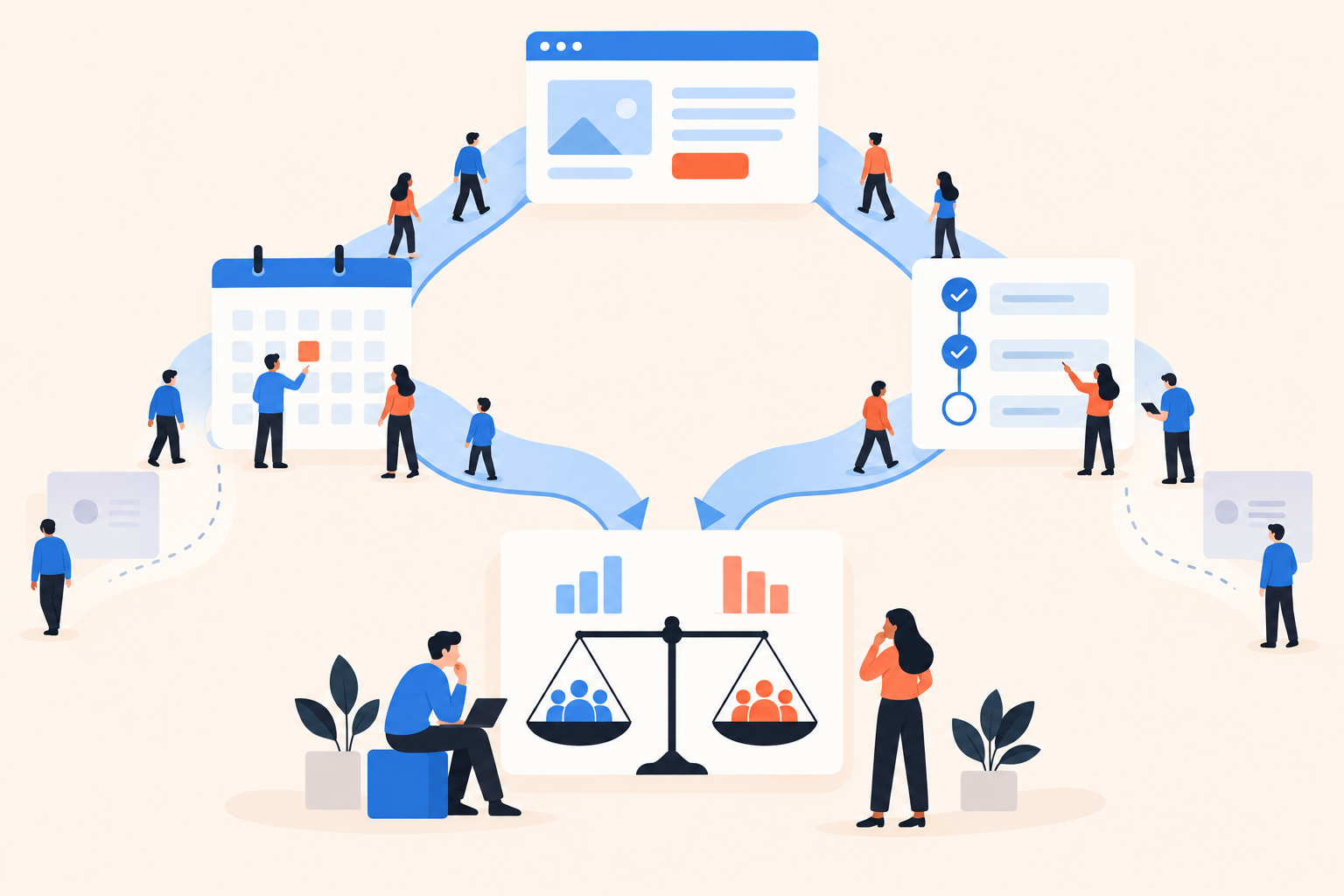
To A/B test demo CTAs fairly, randomly assign eligible visitors to the booking journey or the self-serve journey, then compare a predefined qualified outcome per assigned visitor. Give both groups the same time to reach that outcome, and use engagement data to explain the result, not declare the winner.
I wouldn't restore the booking button just because meetings dipped. But I wouldn't celebrate demo starts, either. The test needs to distinguish useful buyer progress from an attractive new thing to click.
What should a demo CTA A/B test measure?
Measure a commercial outcome that both journeys can produce, such as qualified meetings held per eligible assigned visitor. Choose the outcome before launch, while nobody has a favorite chart.
Demo CTA A/B test: A randomized comparison of demo entry experiences, judged against the same downstream outcome and observation window.
“Interactive demos convert better” is too vague to test. Better: “Visitors to our approval-workflow page will be more likely to attend a qualified meeting if they can explore that workflow before scheduling.”
Now there's something concrete to build and measure.
Agree on what “qualified” means. For an illustrative workflow-software company, that might mean a business in the target market, an approval process the product supports, and a buyer willing to discuss changing it. Apply the same standard to both variants.
If opportunities are accepted quickly and consistently, use sales-accepted opportunities per assigned visitor instead. Track opportunity value too, but inspect the deal mix: one unusually large opportunity can dominate a small test.
Keep sales effort as a supporting measure. Fewer introductory calls could be valuable, but time saved isn't permission to ignore a meaningful pipeline decline.
How do you set up a fair demo CTA test?
Start with the existing booking journey and one clearly defined self-serve alternative. Randomize eligible visitors, preserve their assignment where possible, and leave unrelated page changes out.
First, decide what you're testing. Changing “Book a demo” to “Talk to an expert” with the same calendar destination is a copy test. Opening an interactive product tour instead of a calendar is a journey test. Don't describe the second as a button-color experiment with bigger ambitions.
- Choose the audience. Start with a relevant product or use-case page. Define consistent exclusions for employees, test traffic, and known bots.
- Document the control. Include the form fields, calendar availability, confirmation page, reminders, and lead owner.
- Specify the treatment. State what buyers can explore, when you ask for details, and how they reach sales.
- Preserve assignment. Returning visitors should generally see the same variant, within your consent and identification constraints.
- Set decision rules. Name the primary outcome, meaningful improvement, acceptable downside, and analysis method.
Changing the demo and follow-up together is legitimate if you're testing that combined journey. Just don't claim the demo alone caused the result.
Run a rehearsal before launch. Open each variant, complete its next step, and check the CRM record. A missing experiment field is easier to fix before real buyers arrive.
What should the self-serve demo actually show?
Show the workflow promised by the page and CTA, with a visible route to a sales conversation. Don't make visitors sit through a company introduction before reaching the problem they came to investigate.
On an approval-software page, I'd show a request arriving, an approver finding the relevant context, and the decision appearing in the audit trail. That's a product story. A tour of every navigation menu isn't.
Use one delivery format initially:
| Format | When I'd consider it | What I'd check first |
|---|---|---|
| Inline embed | The workflow supports the page's explanation | Whether visitors reach the embed |
| Click-triggered popup | The existing CTA is a natural entry point | Loading, closing, keyboard access, and mobile layout |
| Dedicated demo page | The experience needs more room | Assignment surviving the page transition |
Keep the label honest. “See the approval workflow” shouldn't unexpectedly open a booking form. If contact details are required, make that expectation clear.
Test on a phone, not just a resized desktop browser. An unreadable interface or hidden sales link can turn a delivery defect into an apparent rejection of self-serve buying.
How do you connect CTA assignment to pipeline?
Record assignment before the visitor interacts, then carry that variant into identifiable lead and CRM records where possible. Analyze all eligible assigned visitors, including those who never click.
This is an intent-to-treat comparison: people stay in the group they were assigned. Comparing demo viewers with calendar bookers instead selects different kinds of buyers. The person willing to book immediately may already be further along.
Your measurement chain should distinguish:
- Assignment to a variant.
- Actual exposure to the CTA or embed.
- Click and successful destination load.
- Demo start or booking-form open.
- Contact identification or meeting booking.
- Qualified meeting held and opportunity accepted.
Exposure matters diagnostically. A visitor assigned to an embed may leave before scrolling to it. Keep that visitor in the primary comparison, then use exposure data to investigate placement.
Demo engagement analytics can explain what happened inside the experience. They don't replace the assignment record or the CRM outcome.
Document identity gaps rather than hiding them. Cookie restrictions, cross-device browsing, and anonymous visits limit what you can connect. Don't join a demo session to a lead because their timestamps look close.
Also check duplicate contacts and shared accounts. Colleagues can receive different variants and forward links. For an account-focused sales motion, discuss account-level assignment and analysis with an analyst if reliable account identification is available.
Where does demo automation fit in the experiment?
Dale, the demo automation platform, can provide the self-serve treatment and its buyer engagement data. Keep random assignment and experiment analysis in your website testing and analytics setup; don't assume interactive demo software includes native experimentation.
For a focused workflow, a Basic Demo (Single Experience Demo) presents one product story with optional Walkthroughs, attachments, and CTAs. Walkthroughs use screenshots, tooltips, and highlighted areas to let viewers click through the product.
If buyers need different levels of detail, a Linear Demo personalized by topic priority lets them rate topics Important / Somewhat Important / Not Important. Important topics play first, while topics marked Not Important are skipped.
Pages hold reusable topic content. Freeze that content during the experiment where practical, so an edit to a shared Page doesn't quietly change the treatment halfway through.
A Branched Demo routes viewers through preset choices, such as role or use case. Use it when those choices materially change the story, not simply because branching is available.
Buying Intent Signals from demo behavior, including topic ratings, rewatches, and link clicks, help explain buyer interest. They aren't proof that the treatment caused pipeline growth.
Try the Dale interactive demo as a buyer would, then check Dale pricing for the demo types, embed capabilities, and follow-up features your design needs.
How do you stop sales follow-up from distorting the result?
Give comparable leads comparable response standards, with named owners and consistent qualification criteria. Where the journeys require different follow-up, document that difference as part of the test.
A calendar booking already has a next step. An identified demo viewer may have explored the workflow without requesting a conversation. Sending both the same message isn't fairness; it's ignoring what each buyer did.
Instead, define appropriate handling. Booked meetings get normal preparation and reminders. Viewers eligible for outreach get a relevant note from the assigned owner, within an agreed response window. Contact capture alone shouldn't be treated as permission for every outreach sequence.
Keep staffing realistic. A special task force personally chasing every treatment lead tests a service level you may never sustain. Leaving those leads in an unmonitored queue tests neglect.
With Dale, Segments can group contacts by behavior, and Campaigns can send automated follow-up when contacts join a segment. If those features are part of the treatment, include their setup and operating effort in the evaluation.
Check the CRM and workflow integration options before promising a handoff. HubSpot is native; Salesforce and other CRMs connect through Zapier or webhooks. Verify the fields and activities your own measurement process requires.
How long should a demo CTA test run?
Run enrollment long enough to support your planned analysis, then give every enrolled visitor the agreed outcome window. A fixed calendar deadline isn't evidence that the test has enough information.
Estimate the sample requirement using the baseline conversion rate and the smallest improvement worth acting on. If qualified opportunities are rare, you may need more traffic or time than the team expects.
Separate enrollment from maturation. Someone assigned on the final day still needs time to book, attend, and progress. Comparing mature control opportunities with fresh treatment leads will punish whichever group has younger outcomes.
Don't repeatedly check a conventional significance threshold and stop when it turns favorable. Use a fixed analysis plan or an appropriate sequential method. Monitor technical failures and serious downside throughout, but distinguish safety checks from winner selection.
For low-traffic sites, interviews and usability sessions can expose confusing steps. They cannot establish causal pipeline lift. Sometimes the honest result is “inconclusive,” followed by a narrower test or an explicitly judgment-based decision.
What if clicks rise but meetings fall?
Judge the predefined qualified outcome first, then investigate the change in bookings and engagement. Fewer bookings can indicate better self-selection, added friction, or a broken journey; the click count won't tell you which.
- More clicks, unchanged qualified meetings: Check whether visitors find the promised workflow and a clear next step.
- Fewer bookings, more qualified meetings held: Inspect attendance and fit. Buyers may arrive better prepared.
- More qualified meetings, fewer accepted opportunities: Check qualification consistency and outcome maturity before celebrating.
- Similar pipeline, less repetitive sales work: Assess uncertainty and measured time savings. No statistically significant decline doesn't prove the experiences are equivalent.
Use device and traffic-source breakdowns to diagnose problems, not hunt for a winning slice after the overall result disappoints. If mobile loading is broken, fix it and document the change. You may need to restart rather than pool materially different treatment versions.
What belongs on the launch checklist?
Launch when marketing, sales, and analytics can trace both paths to the same defined outcome. The brief should make disagreements visible before traffic starts.
- Promise: The CTA opens what it says it opens.
- Assignment: Variant records survive the journey into identifiable conversions.
- Experience: Mobile, keyboard access, loading, and sales links are checked.
- Ownership: Leads have a responsible rep and no conflicting outreach.
- Decision: Denominator, qualification rules, sample approach, and maturity window are written down.
Pick one high-intent page. Have a marketer and a sales rep complete both journeys, then ask your analyst to find those test records. Don't send live traffic until the outcome you plan to count is actually traceable.